Roof cavities across Nueces County endure chronic coastal heat and high humidity, which accelerates the breakdown of animal excretions. In waterfront pockets like Mustang Island and North Beach, attic spaces frequently…
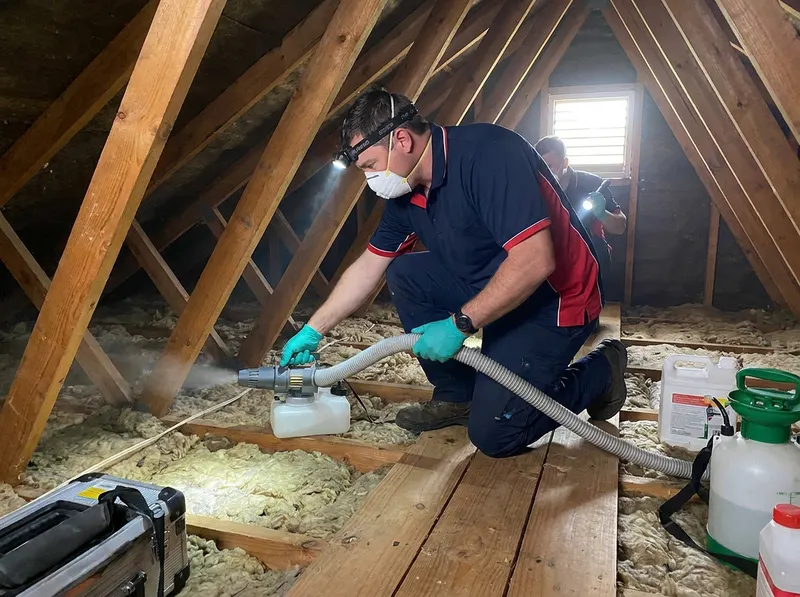
Roof cavities across Nueces County endure chronic coastal heat and high humidity, which accelerates the breakdown of animal excretions. In waterfront pockets like Mustang Island and North Beach, attic spaces frequently reach internal temperatures exceeding 130 degrees Fahrenheit during summer months. When roof rats (Rattus rattus) or Mexican free-tailed bats colonize blown cellulose insulation under these conditions, biological waste releases airborne pheromones, histoplasmosis spores, and secondary parasites like rodent mites directly into the porous ceiling drywall of the living quarters below. Standard trapping addresses the living wildlife, but true barrier preservation demands deep physical extraction of the biochemical residue to deter secondary invaders drawn by scent markings.
Decision guidance relies on contamination severity: light droppings confined to a single truss line fit spot decontamination ($200 to $450) without disrupting structural material; widespread rodent tunneling across 1,500 square feet requires a full structural vacuum extraction and complete thermal replacement ($2,200 to $5,250). The operational trade-off centers on upfront removal expenditure versus continuous duct and drywall contamination; skipping sanitization leaves acidic urine deposits to degrade electrical wiring sheathing and sub-roof joists. Properties near Cayo del Oso, Lamar Park, and Del Mar often feature older ranch construction where attic air naturally circulates through wall voids, meaning untreated attic contaminants systematically lower indoor air quality through normal HVAC pressure cycles.
Technicians use HEPA-filtered vacuum machinery stationed
Tell us about your attic pest decontamination and sanitization job in Corpus Christi and we'll send a clear, written quote, usually the same day.
 Evorin Pest Patrol