Corpus Christi features expansive, moist clay soils alongside high water tables that create an ideal reproductive habitat for subterranean termites. In neighborhoods such as Lamar Park and Bay Area, older pier-and-beam…
Corpus Christi features expansive, moist clay soils alongside high water tables that create an ideal reproductive habitat for subterranean termites. In neighborhoods such as Lamar Park and Bay Area, older pier-and-beam foundations allow termites to construct shelter mud tubes across crawlspace piers directly into subflooring. Conversely, monolithic slab homes in Calallen, Flour Bluff, and South Shore frequently face perimeter breaches through plumbing slab cutouts and expansion joints hidden beneath tile or carpet. The brackish humidity adjacent to Cayo del Oso and Mustang Island accelerates moisture retention near exterior stem walls, attracting colonies that can contain upwards of 1 million workers.
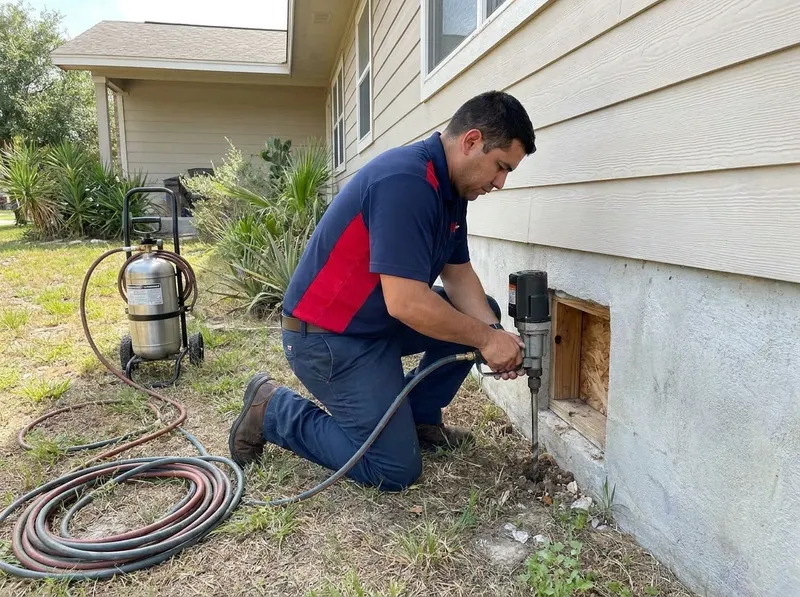
Non-repellent liquid barrier treatments, such as fipronil, represent the primary defense standard across Nueces County. For existing slab properties, a continuous vertical barrier requires trenching exterior soil 6 inches wide by 6 inches deep and saturating the trench at a rate of 4 gallons per 10 linear feet per foot of depth. Where flat concrete, such as patios, driveways, or sidewalks, meets the exterior brick or siding in Del Mar or Annaville, specialized rotary drills bore holes every 12 inches to inject termiticide directly beneath the slab. If localized activity is detected around an isolated plumbing leak, an owner may choose a targeted spot treatment; however, whole-perimeter defense remains the only technique that stops satellite colonies from finding adjacent untreated expansion gaps.
Subterranean termite defense differs fundamentally from drywood termite procedures. Drywood species nest directly inside dry framing, attics, and fascia boards without requiring ground moisture, often addressed through structural fumigation or localized wood injection. Subterranean species require constant connection to soil moisture to prevent desiccation; treating only the above-ground wood structure fails because the subterranean central nest remains active in the ground below. Formosan colonies along North Beach can also establish aerial carton nests if secondary roof or pipe leaks supply uninterrupted moisture, requiring simultaneous structural moisture repairs alongside ground-level chemical barriers.
Every job gets a firm, written price after a free on-site visit.
Tell us about your subterranean termite treatment job in Corpus Christi and we'll send a clear, written quote, usually the same day.
 Evorin Pest Patrol