Corpus Christi properties face continuous flea and tick pressure due to Nueces County's subtropical humidity, sandy coastal soils, and minimal winter freeze events. A professional yard treatment differs from basic…
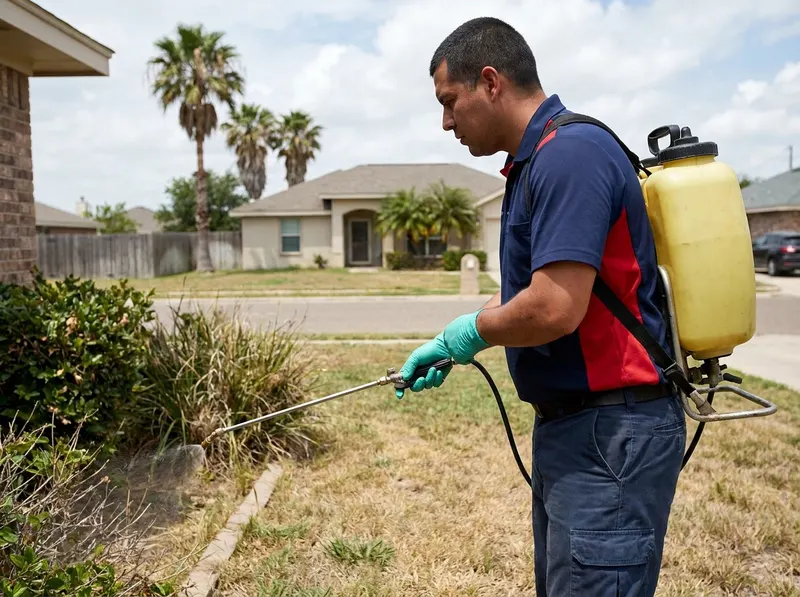
Corpus Christi properties face continuous flea and tick pressure due to Nueces County's subtropical humidity, sandy coastal soils, and minimal winter freeze events. A professional yard treatment differs from basic pet-topical treatments by addressing the 95 percent of the parasite population that exists outdoors as eggs, larvae, and pupae. Granular and microencapsulated liquid formulations are applied to shaded run areas, beneath coastal decks, and through heavy turf grass like St. Augustine, where female ticks deposit egg masses of up to 4,000 eggs. The treatment leaves an active residual barrier that bonds with soil particles and foliage surfaces, resisting immediate wash-off from Gulf sea mist and afternoon rainstorms.
Neighborhood properties near water boundaries experience distinct parasite vectors. Dense coastal brush around Cayo del Oso, low-lying moisture in Flour Bluff, and canal-adjacent yards on Mustang Island frequently encounter wildlife hosts like opossums, raccoons, and feral cats that continuously drop flea eggs into exterior bedding zones. Properties inland toward Calallen and Annaville contend with open-field tick migrations into privacy fence perimeters. The protective service systematically targets perimeter transit corridors, low-hanging palm fronds, shaded under-deck zones, and mulch layers in Lamar Park and Del Mar, neutralizing developing nymphs before they can be carried indoors by family pets.
Effective exterior flea suppression operates on a life-cycle interruption sequence rather than a single topical knock-down. While standard contact adulticides kill active adult biters within 2 to 4 hours, adult fleas make up only roughly 5 percent of an active infestation. The critical secondary mechanism is an insect growth regulator (IGR), such as pyriproxyfen, which prevents flea larvae from pupating and sterilizes adult females. Because flea pupae remain protected inside impervious silk cocoons for up to 30 days before hatching, full mechanical break of the biological cycle generally takes 14 to 21 days following initial application. The service trade-off involves outdoor yard coverage versus indoor pet management: exterior yard treatments eliminate the breeding reservoir outside, but indoor veterinary treatment of domestic animals remains necessary to prevent indoor re-infestation.
Every job gets a firm, written price after a free on-site visit.
Tell us about your flea and tick yard treatment job in Corpus Christi and we'll send a clear, written quote, usually the same day.
 Evorin Pest Patrol