Rodent exclusion functions as an architectural defense rather than a recurring chemical application. In coastal South Texas, rodent control requires permanent physical barriers because baiting alone leaves entry…
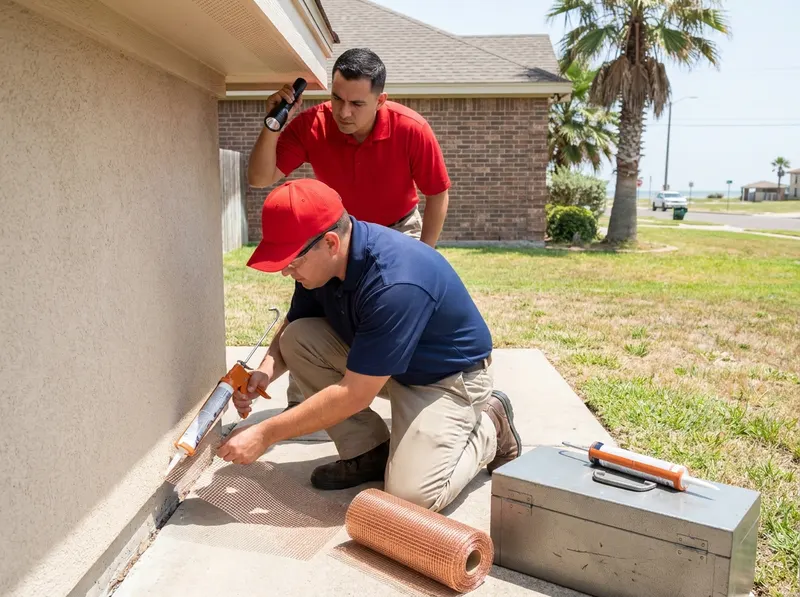
Rodent exclusion functions as an architectural defense rather than a recurring chemical application. In coastal South Texas, rodent control requires permanent physical barriers because baiting alone leaves entry pathways open to recurring neighborhood populations. Roof rats exploit palm fronds and live oak branches in older neighborhoods like Lamar Park, Del Mar, and the Bay Area, running along service wires to access soffit vents, loose fascia boards, and attic gable vents. Ground-level rodents, including Norway rats and house mice, leverage the high water table near Cayo del Oso and South Shore to nest in dense brush before seeking foundation voids, weep holes, and garage door weatherstripping gaps.
A rodent exclusion installation relies on corrosion-resistant materials designed to survive salt-spray exposure along Mustang Island and North Beach. Standard exclusion hardware includes 19-gauge hot-dipped galvanized 1/4-inch steel hardware cloth, aluminum flashing, and copper wire mesh packed behind polyurethane elastomeric sealants. Technicians systematically secure every void larger than 0.25 inches, which corresponds to the skull diameter of an adult field mouse, while openings larger than 0.5 inches are reinforced against roof rats. Weep holes in brick veneers across Calallen and Annaville receive breathable stainless steel weep inserts, which permit essential wall-cavity air circulation while preventing pest ingress.
Decision guidance dictates that structural exclusion is the correct approach when droppings, shredded insulation, or scratching noises occur inside crawlspaces, attics, or wall voids. Trapping alone reduces active interior populations within 3 to 7 days, but exterior exclusion prevents subsequent outdoor colonies from recolonizing the attic during seasonal cold snaps or heavy rains. The mechanical installation trade-off involves upfront material labor rather than passive bait maintenance, delivering a continuous physical barrier that protects crawlspaces, subfloors, and AC condensate chases from gnawing damage.
Every job gets a firm, written price after a free on-site visit.
Tell us about your rodent exclusion service job in Corpus Christi and we'll send a clear, written quote, usually the same day.
 Evorin Pest Patrol